
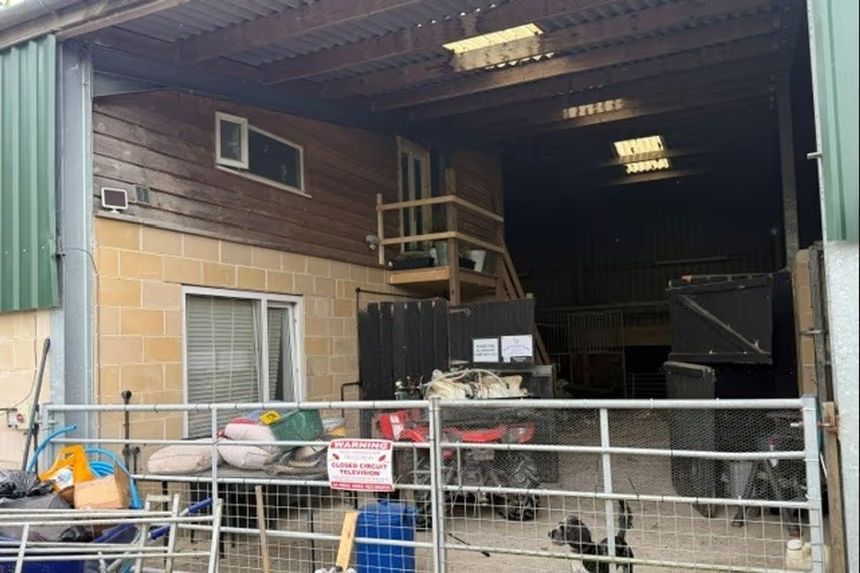
Planning enforcement disputes can escalate quickly when landowners choose not to engage with the process. A Derbyshire sheep farmer is now experiencing the consequences. Helen Lowe, 59, faces the prospect of a prison sentence after refusing to stop living in a home she built inside an agricultural barn on her farm near Matlock without planning permission.
Ms Lowe converted part of the barn into living accommodation, which included a bedroom, a shower room, and a kitchen. The accommodation was built largely from breeze blocks and UPVC windows. She sold her nearby bungalow and moved into the barn during the Covid-19 pandemic in 2020, and says the space was intended mainly to help her care for her sheep during lambing season rather than to serve as a permanent home. She also disputes the council’s claim that the building had been hidden from view.
Derbyshire Dales District Council takes a different position. It argues that the structure amounted to an unauthorised dwelling that had been concealed within the barn to avoid detection, and has maintained that view throughout a six year dispute. It first issued an enforcement notice in 2020. Ms Lowe appealed, but the Planning Inspectorate dismissed her appeal in 2022 and directed her to stop using the barn as a home. When she continued living there, the council obtained a court order in 2024 requiring her to vacate the building and carry out demolition works.
Ms Lowe’s continued failure to comply resulted in contempt of court proceedings, and Nottingham County Court found Ms Lowe guilty on 18 May 2026. She has now been given until 24 July 2026 to demolish the structure, and if she does not comply, she could receive a prison sentence of up to two years, an unlimited fine, or both. The court has also ordered her to pay the council’s costs, which were initially set at £10,000, although the final amount is expected to increase once it has been assessed.
This case provides a useful illustration of how planning enforcement can escalate when a landowner does not engage with the process at an early stage. Once an enforcement notice has been issued and an appeal has been dismissed, continuing to use land or buildings in a way that has been found to be unlawful does not simply invite further enforcement action. It can also lead to contempt of court proceedings and a genuine risk of imprisonment.
Anyone who receives an enforcement notice, or who is considering converting an agricultural building for residential use, should seek legal advice before committing significant time or money to the project. Permitted development rights, the appeals process, and the consequences of failing to comply with a court order can all be complex. Obtaining legal advice at an early stage can prevent a planning issue from developing into a much more serious legal dispute.
It's not like I live at Windsor Castle...
https://www.bbc.co.uk/news/articles/cwy20de67l1o

Recent posts by Milan Oakland
Share this



/Passle/60d59e96e5416a116451a194/SearchServiceImages/2026-10-16-11-39-43-079-6ad20cffb378b0c78cec621a.jpg)
/Passle/60d59e96e5416a116451a194/SearchServiceImages/2026-10-01-12-30-02-942-6abe524ad635d8950c1800b5.jpg)
/Passle/60d59e96e5416a116451a194/SearchServiceImages/2026-10-13-10-01-02-938-6ace015e215a8c2ff547b57e.jpg)