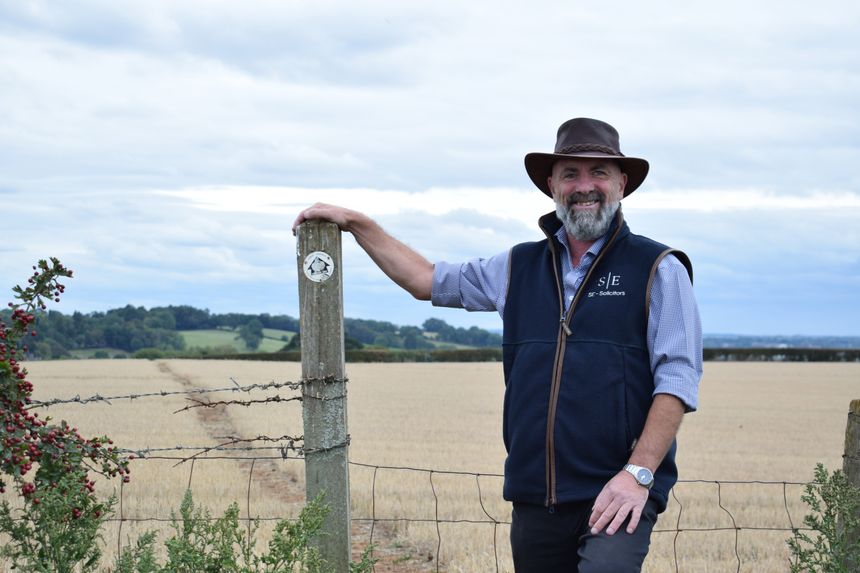
Across Oxfordshire, significant change is taking place in how land is being planned, developed and used. New housing and commercial development, infrastructure projects and changing patterns of land use are creating opportunities for landowners and developers – but they can also bring longstanding land issues to the surface.
Oxford City Council is progressing a new Local Plan covering development to 20451, while substantial housing and employment development is also planned elsewhere across Oxfordshire and neighbouring counties2. For farmers, landowners and developers considering the future potential of land, understanding exactly what rights exist over it is therefore becoming increasingly important.
One issue that can easily be overlooked is the existence of historical rights that may have been forgotten or the potential future creation of a public right of way.
How can rights of way issues arise?
Public rights of way are often associated with footpaths crossing farmland and countryside3. In reality, they can affect agricultural, residential and commercial land alike and can come to light in several different ways.
An historic route may be discovered through old maps, enclosure awards or other archive material despite having disappeared from physical use many decades ago. Alternatively, plans to develop a site may prompt an application seeking formal recognition of a route that members of the public believe already exists.
Rights can also potentially arise through use over time. Broadly speaking, where the public has used a route openly and without permission for a sufficiently long period – commonly 20 years – an application may be made for that route to be recognised as a public right of way.
A recent dispute concerning Barton Court near Kintbury in Berkshire illustrates how closely that evidence can be examined. Local walkers sought to have a driveway across the estate formally recorded as a public footpath, arguing that it had been used by villagers for generations. Following a public inquiry, however, the Planning Inspector declined to confirm the route. Reports of the decision indicate that the evidence was insufficient to establish the necessary public use, with the limited frequency of use, historic signage and evidence from previous owners all relevant to the outcome.
The case demonstrates that neither long-held local belief nor the fact that access may previously have been tolerated will necessarily establish a public right of way. Equally, privacy or security concerns alone will not determine the legal status of a route. The outcome will depend on the history of the land and the strength of the evidence.
While in this case the public right of way was declined, the broader issue can apply to locations that would not immediately appear to present a risk, for example, a commercial car park. While that may cause little concern while the existing use continues, it can become much more significant if the owner subsequently wants to redevelop the site.
Similar issues can arise with applications to register land as a town or village green, particularly where land that has historically been used informally for recreation is earmarked for development.
Why identifying the issue early matters
A right of way does not simply disappear because land is being developed.
There are a number of examples of where an application was made to recognise an historic route running diagonally across a field earmarked for housing. If the developer built according to their plans, which did not take the route in account, and that route was subsequently confirmed, the consequences could have been significant – not just for the developer but subsequent homeowners. Rather than wait for the application to work its way through the system, which could have taken years – the developer redesigned the proposed layout so the disputed route could be accommodated if necessary.
It is a valuable illustration of why these issues are best considered before development plans become fixed or significant expenditure has been committed.
For anyone purchasing land with development potential, or landowners considering redesignating land for development, undertaking due diligence at an early stage can also identify potential constraints that may affect future use, value or the viability of a proposed scheme.
When should you seek legal advice?
Ideally, before a dispute develops.
If you are purchasing, selling or considering developing land, legal advice can help establish whether existing public or private rights affect the site and whether there is evidence of other potential claims.
Landowners can also take steps to protect themselves against certain future claims. For example, Oxfordshire County Council provides a process through which landowners can deposit statements identifying the public rights of way they acknowledge and subsequently make declarations confirming that they have not dedicated additional routes. This cannot extinguish rights that may already have arisen, but it can provide protection against certain future claims.
Where an application or dispute has already arisen, early advice can help clarify the nature of the right being claimed, the strength of the supporting evidence and the practical options available.
How long can a rights of way dispute take?
Potentially, a considerable time.
Public rights of way cases can involve detailed examination of historic documents, maps, witness evidence and patterns of use. Where an order is disputed it may ultimately be referred to the Planning Inspectorate and, in some cases, proceed to a public inquiry.
Current applications can spend many years within the system before reaching a final determination. For a developer working to a much shorter commercial timetable, simply waiting for an outcome may therefore be unrealistic.
The important question is often not just whether a claimed right will ultimately be confirmed, but how the risk can be managed while the process continues.
Understanding the land before plans are fixed
With development and land-use change continuing across Oxfordshire, rights of way can have consequences far beyond access to a footpath.
For farmers, estates, commercial property owners and developers, identifying potential issues early provides the greatest opportunity to manage them pragmatically – before they might affect what can be done with the land.
Derek Walsh is a Director in SE-Solicitors’ Dispute Resolution team and has more than 20 years’ experience advising on agricultural, commercial and property disputes, with particular expertise in public rights of way.
For advice concerning public rights of way, land or property disputes, please contact Derek Walsh.
Sources:
1 Oxford City Council – Local Plan 2045
https://www.oxford.gov.uk/oxford-local-plan-2045
2 Campaign to Protect Rural England
https://www.cpreoxon.org.uk/care/your-local-plan/
3 Proposals on public rights of way
https://letstalk.oxfordshire.gov.uk/hub-page/public-rights-of-way-commons-and-village-greens